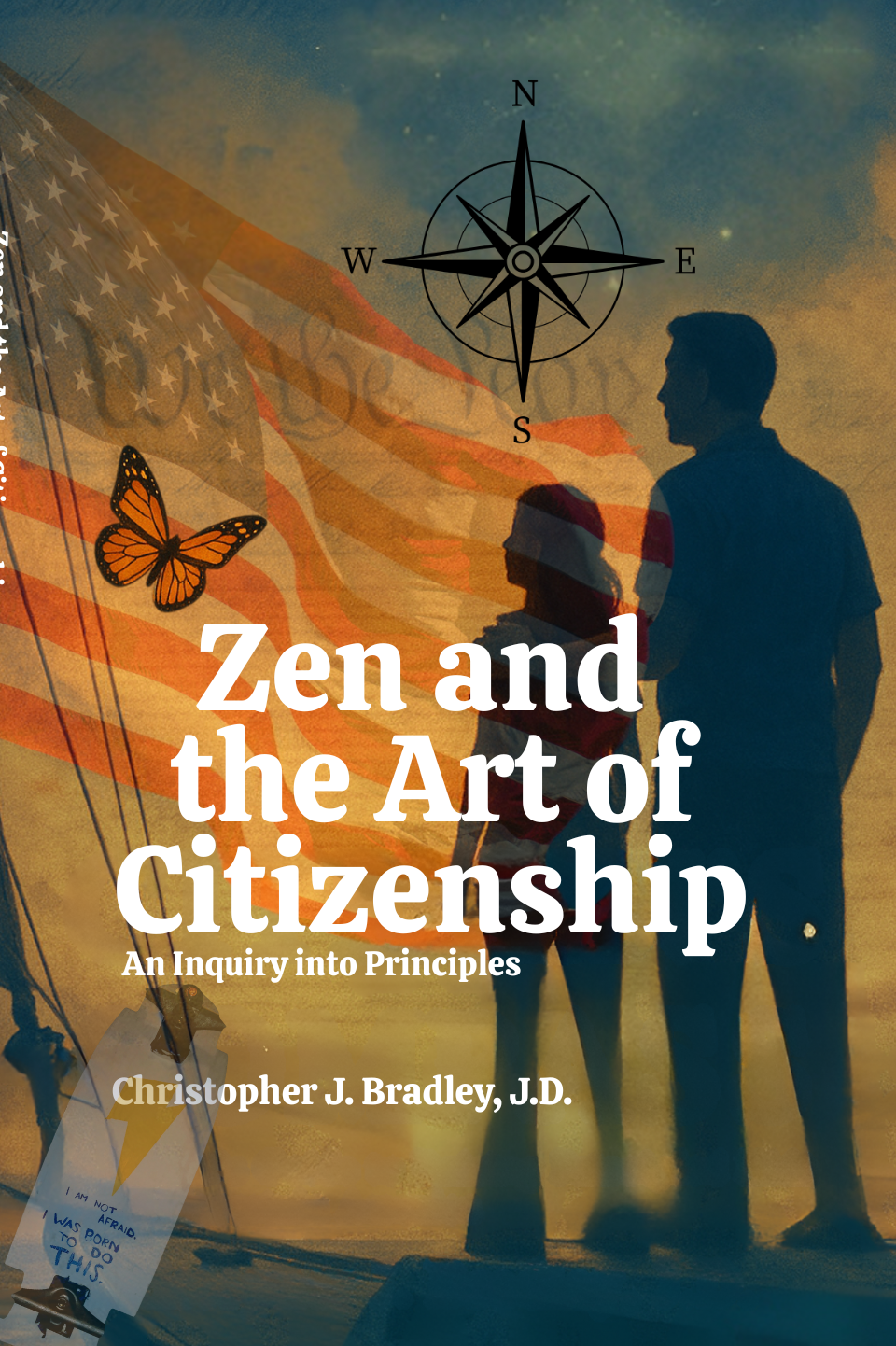
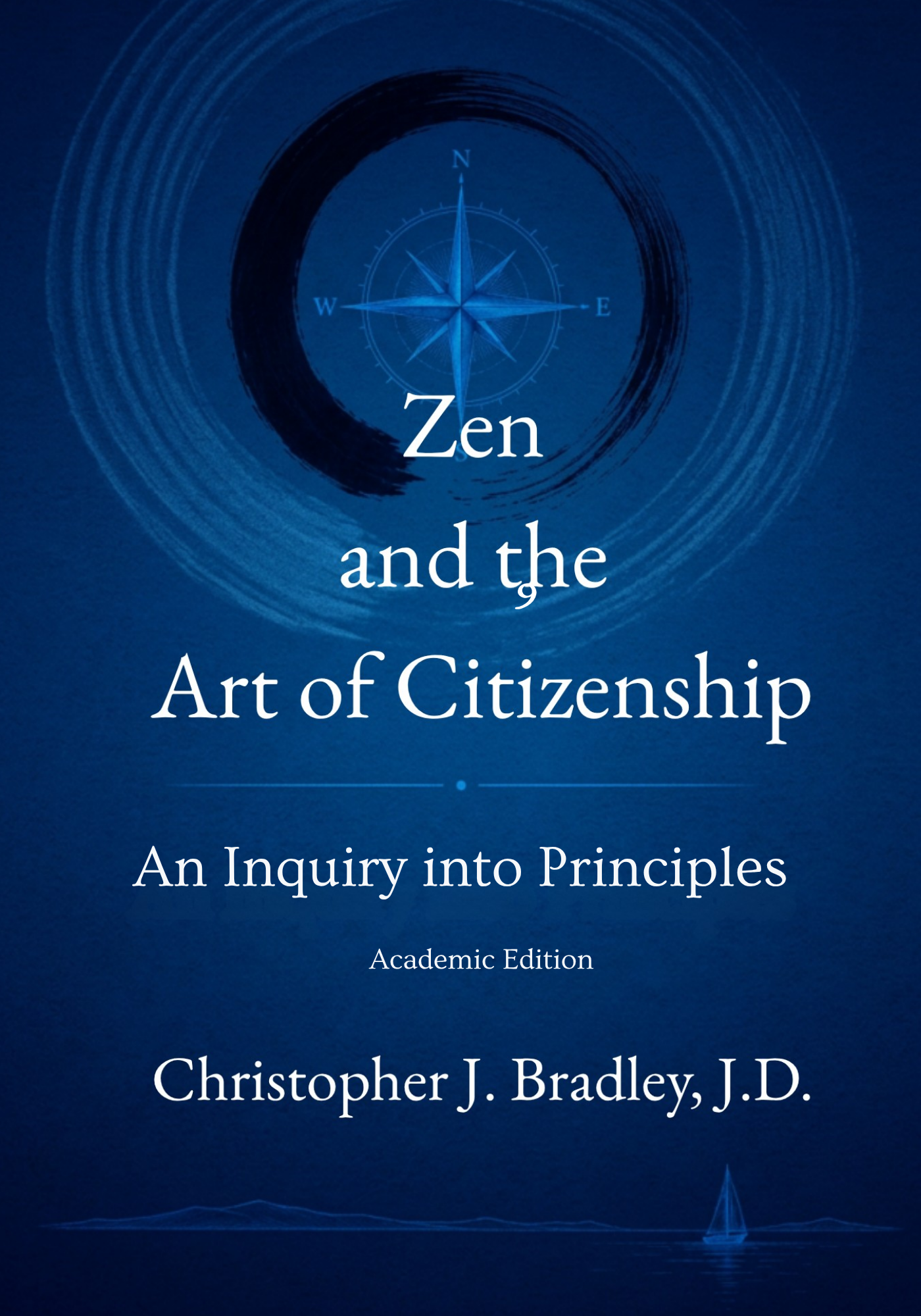
Zen and the Art of Citizenship
An Inquiry into Principles
What does it mean to be a citizen? Not in theory — but in the life you actually live? In the family you raise, the oath you swear, the vote you cast, the office you run for, the principles you defend?
Christopher J. Bradley — Gulf War veteran, lawyer, father, pamphleteer — answers that question through 25 chapters of lived experience, woven together with America's founding principles. Part memoir, part manual. Entirely human.
By Christopher J. Bradley, J.D.
The Crisis of Civic Illiteracy
How can we preserve what we don't understand?
of Americans cannot name all three branches of government
— Annenberg Public Policy Center
cannot name a single right protected by the First Amendment
— Freedom Forum Institute
of U.S. citizens would pass the citizenship test immigrants must take
— Woodrow Wilson Foundation
"The Founders didn't just win a revolution. They built a framework — a set of principles so carefully constructed that, if followed, they make tyranny nearly impossible. The question is whether we still know what those principles are."
A Different Approach to Civic Education
This book isn't another dry textbook or partisan manifesto. It's a personal guide to understanding and exercising your role as a citizen — part memoir, part manual, entirely human. Available in two editions.
"Citizenship is not a passive condition. It is an active practice — a daily choice to know your rights, understand your responsibilities, and participate in the great ongoing experiment of self-governance."
Trade Edition
The Memoir — For the General Reader
Christopher's life story in his own words — 25 chapters from rural Pennsylvania to the Gulf War, from courtrooms to homelessness, from a sailboat in the Florida Panhandle to civic engagement. The story, without the reference material.
- 25 memoir chapters + prologue & introduction
- Reflection questions
- Family Compass Activities
- Liberty's Principles Pals story tie-ins
Academic Edition
The Complete Edition — Memoir + Full Principles Reference
Everything in the Trade edition, plus a comprehensive reference on America's founding principles — definitions, historical foundations, Federalist Papers connections, landmark Supreme Court cases — and seven appendices of primary sources, including the original 1988 Sock Petition documents.
- Everything in the Trade edition
- Preamble + 25 founding principles reference
- Federalist Papers & landmark case guide
- 7 appendices, incl. original 1988 Sock Petition documents
The Founding Principles
A Preamble and 25 principles — ordered by the arc of a human life, from the individual to the family to society to governance. Each is explored in depth with historical context, Federalist Papers connections, landmark court cases, personal reflection, and family activities.
The Creator, Divine Law, and the Role of Religion
The moral framework that precedes government — the foundation everything else stands on.
Natural Law Precedes All
The laws of nature and nature's God are the foundation of all just human law.
The Family Is the Core Unit of Society
Strong families build strong nations — the family is where citizenship begins.
A Free Society Needs an Educated People
An educated citizenry is the guardian of liberty — self-governance demands civic literacy.
Majority Rule, Minority Rights
The majority governs, but never at the expense of the minority's unalienable rights.
Only Moral and Virtuous People Can Self-Govern
Self-governance requires citizens of character — virtue is not optional.
Virtuous Leaders
Those who govern must themselves be governed by principle, not power.
Equality for All
All citizens are equal before the law — equal rights, not equal outcomes.
Unalienable Rights
Life, liberty, and the pursuit of happiness cannot be surrendered or taken away.
Property Rights
Property rights underpin all other freedoms — without them, liberty has no anchor.
A Free People Must Stay Strong
National defense is a prerequisite for freedom — strength secures self-governance.
Peace, Commerce, and Honest Friendship
Trade and honest friendship with all nations — entangling alliances with none.
Free Market Economy
Economic freedom produces the greatest human flourishing.
The Burden of Debt
Fiscal irresponsibility enslaves future generations without their consent.
Governed by Law, Not by Men
The rule of law — not the rule of men — is the foundation of justice.
Sovereign Authority of the Whole People
Ultimate sovereignty rests with the people, not any ruler or party.
The People May Alter or Abolish
The people retain the ultimate check on government that has become tyrannical.
The United States Should Be a Republic
A constitutional republic protects minority rights from majority tyranny.
The Constitution Protects from Human Frailties
The Constitution is a covenant with future generations — structured to endure.
The Importance of a Written Constitution
A written constitution is the supreme law — binding on government itself.
Strong Local Self-Government
Power closest to the people is most accountable and most free.
Limited and Defined Powers
Enumerated powers constrain government — all other powers belong to the people.
Separation of Powers
Dividing government into three branches prevents any one from becoming tyrannical.
Checks and Balances
Power must be divided and balanced to remain accountable.
Protect Equal Rights, Not Provide Equal Things
Government secures opportunity — it cannot guarantee results.
America's Mission
America's purpose is to be a lighthouse of liberty, not an empire.
Each principle is explored in depth in Part Two of the book — with definition, historical foundations, Federalist Papers connections, landmark court cases, and family activities. Ordered by the arc of a human life — not academic taxonomy.
Explore All 25 Principles in the BookThe Journey
From the fields of Pennsylvania to the sands of the Gulf War, from courtrooms to a sailboat on the Florida coast — 26 chapters of a life lived in search of truth, purpose, and justice.
The Books That Find You
At Bar Thalia in New York, Malachy McCourt tells a young writer: "Your voice will find you." Six books, a Dharma wheel, and a compass point toward a question: What does it mean to be a citizen?
Family, Unity & Principles
From a Jersey City birth within sight of the Statue of Liberty to a Pennsylvania farmhouse built by hand. Chapters 1–4 trace the values instilled in childhood that would shape everything to come.
The Sock Petition
At 17, Christopher organized a student petition against a discriminatory dress code — backed by the ACLU, presented to the school board, and preserved in Appendix G as original primary source documents. His first lesson in how principles meet power.
Enlistment, Deployment & the Gulf War
Why government must be limited. Seeds of enlistment. Swearing the oath at 17. Deployment to Saudi Arabia. Operation Desert Storm with the 1st Cavalry Division — M1A1 Abrams tanks, 100 hours of ground war, and a ceasefire that didn't end the questions.
The Search for Meaning & the Courtrooms of America
After the war: the GI Bill, Penn State, law school at Franklin Pierce. The search for meaning, lessons in justice, and the courtrooms of America. The principles he swore to defend become the lens through which he practices law.
September 11, Grace & Henry Metz
Return to New York. September 11 and the architecture of grief. Grace found in the lowest places — including homelessness. A conversation with Holocaust survivor Henry Metz that changes everything.
Dinners in Destin, Music & Running for Office
Life aboard a sailboat on the Florida Gulf Coast. 2,000 sunsets. The music never heard together. And running for Fort Walton Beach City Council — broke — because the principles demanded it.
The Machine, The Pamphleteer & America's 250th
Building Liberty's Principles Media. The Pamphleteer's Return. Holding America accountable to its own principles. As America approaches its 250th birthday on July 4, 2026 — a call to every citizen.

"For most of the last decade, I lived on a sailboat along the northwest gulf coast of Florida. I photographed over 2,000 sunsets in the same sacred space and learned the greatest lesson: Life is simple, love everyone and start with you."
— Christopher J. Bradley
A Compass for the Next Generation
Whether you're a parent wanting to pass on America's story, a veteran seeking to deepen your understanding of what you defended, or an educator looking for a principled civic framework — this book is your compass.
"Every principle in this book is a letter to you. Every page is a promise that the country you inherit will be worth the name."

Family Compass Activities
Each chapter ends with concrete activities your family can do together — from reading primary sources to visiting local government meetings. Build the habits of active citizenship one step at a time.
Liberty's Principles Pals
Each chapter includes a Liberty's Principles Pals children's story — a series of 29 books teaching foundational civic values to the next generation in fun, age-appropriate ways.
Florida Civic Literacy Benchmarks
Each principle is mapped to Florida's civic literacy benchmarks, making this book a valuable resource for Florida educators and homeschooling families.
Reflection Questions
Every chapter includes thoughtful reflection questions designed to spark family conversation and deepen understanding of the principles at work in everyday civic life.
Resources for Veterans
Appendix B is dedicated to veterans: crisis resources, PTSD treatment programs, VA benefits navigation, TDIU claims, vocational rehabilitation, and peer support networks — drawn from the author's own experience navigating these systems.
The Citizen's Compass App
Start learning America's founding principles today with the free interactive app — no login required. Explore all 25 principles at your own pace.
Try the App FreeCommon Sense Quarterly
A civic education postcard delivered to households via USPS Every Door Direct Mail. Each edition features founding-era quotes, constitutional principles, local government updates, and Liberty's Principles Pals stories — civic literacy that arrives in your mailbox.
Learn MoreChristopher J. Bradley, J.D.

Christopher J. Bradley was born in Jersey City, New Jersey, within sight of the Statue of Liberty, and grew up in a farmhouse in rural Pennsylvania that his family built by hand. He is a veteran, father, and lawyer who has spent his life navigating systems — legal, military, and personal — in search of truth, purpose, and justice.
He enlisted in the U.S. Army at age 17 and served with the 1st Cavalry Division during Operation Desert Storm. After the war, he earned a joint J.D. and Master of Intellectual Property Law from Franklin Pierce Law Center (now the University of New Hampshire Franklin Pierce School of Law) in 2001, and practiced law in New Hampshire and New York.
After enduring personal loss — homelessness, PTSD, family court, and the long road of rediscovery — he turned his experience into a mission: to help families understand the founding principles that create the foundation for shared civic life.
He is the founder of Liberty's Principles Media and the creator of the Liberty's Principles Pals children's book series, Common Sense Quarterly (a civic education postcard delivered by USPS), and WhatLaw.ai. He currently lives aboard a sailboat in Florida, chasing sunsets, purpose, and a freer future for all.
"Your voice will find you. Six books, a Dharma wheel, and a compass later — I think it finally has."
Original Music
16original songs inspired by the principles that hold America accountable — from arena rock to hip-hop, americana to post-punk. The principles don't belong to one genre, and neither does this music.
Lyrics, discussion questions, and music videos for every track
Let's Continue the Conversation
Whether you're an educator, a veteran, a parent, or simply a citizen who knows something is missing — Christopher would love to hear from you.
Send an Email
Reach out directly — whether it's about the book, speaking engagements, educational partnerships, or just to say hello.
Common Topics
christopher@libertysprinciplesmedia.com